Public local transport is the cheapest way of going around Gozo. Its limit though, is its restricted time-table which at times can be infrequent. Gozo buses are painted grey with red stripe on each side and can carry approximately 50 passengers. The cost per trip does not exceed 20 Malta cents.Gozo route buses serve villages around Gozo from the central Victoria Bus Terminus in Main Gate Street. They are identified by the number they carry on the front (See Bus Schedule below). In Summer, buses operate trips to Dwejra and Ramla Bay, while they increase the trip frequency to Marsalforn and Xlendi Bays
Taxis
Taxis in Gozo are easy to notice, being painted white with a "TAXI" indicator on the roof. They also carry their registration number on the side doors. They are driver-owned and probably the most comfortable way for getting around Gozo. They can be found in Taxi stands, mainly by the ferries at Mgarr, or at Victoria in Triq Putirjal (Main Gate Street), a stone's throw away from the main bus terminus. Taxis in Gozo are all metered.
Self-Drive Cars
This is the most popular and convenient way to get around in Gozo. Below is a list of established Gozo car hirers. The rental rates vary according to car model, length of hire, and season. July to September is considered to be the peak season. However, self-drive car rental in Gozo is said to be reasonably priced when compared to mainland Europe. Drivers must hold a valid driving licence and be over eighteen. Driving is on the left-hand-side of the road and seat belts are compulsory both in the front and rear seats. The maximum speed is 40km/h in urban areas and 60km/h outside urban areas
Hire a car or you will be waiting half your holidays for buses or taxis. It's not expensive if you hire outside hotel.
Monday, 11 June 2007

Friday, 8 June 2007
Malta - Rare Attractions
After some new immigrants arrived in Malta, the so called Temple Culture developed around 4000 BC. The first temples were constructed about 3600 BC. Ggantija in Xaghra (Gozo) is one of them. The temples were built with huge stone blocks and almost always consist of a number of trefoil shaped rooms, interconnected by a corridor.
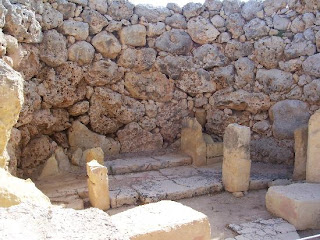
The most visited temples in Malta are
Ggantija in Xaghra (Gozo)
Hagar Qim and Mnajdra, close to the village of Qrendi
Tarxien.
Ggantija in Xaghra (Gozo)
Hagar Qim and Mnajdra, close to the village of Qrendi
Tarxien.
There are many other temple remains in Malta. Some are closed to the public, others are accessible. A good tourist map will show the location of most of them.
In the year 60 AD an event took place that is comprehensively described in the Bible: the shipwreck of the apostle Paul (Acts of the Apostles 27 and 28) . According to the legend this shipwreck took place at St. Paul's Bay. Saint Paul stayed in Malta for three months and performed a number of miracles, like the healing of the father of Publius, the Roman governor. Publius became the first bishop of Malta. Tradition has it, that St. Paul converted the Maltese to christianity, but there is no historical evidence to prove it. The first signs of the existence of a christian community in Malta date back to not earlier than the fourth century. Nevertheless Saint Paul is regarded as the one who brought christianity to Malta; Saint Paul is the patron saint of Malta and the cathedral of Mdina is dedicated to him.
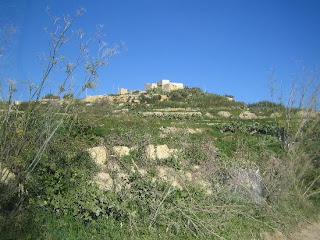
The old city of Mdina still bears a touch of its Arab past: walking through the narrow streets it almost feels like being in a serene version of a North-African town. Yet Mdina has much more remains from more recent times: the late Middle Ages and the 18th century. The Maltese language is a descendent of the Arab dialect that was spoken here during the early Middle Ages, although many Maltese prefer to give it a Phoenician origin. The language is extensively influenced by Italian and English, causing Maltese to be a mixture. Yet the language is a Semitic language, so it is related to Arabic and Hebrew. Maltese is quite a unique language: it is the only Semitic language written with the Latin alphabeth. For most visitors Maltese will be abracadabra , but don't worry: almost all Maltese speak fluent English, the second official language of the country.
The Mdina was the capital of Malta until the arrival of the Knights. Mdina is situated inland and was not a suitable capital for the Knights, since they possessed a fleet. For that reason they settled in the small town of Birgu, at one of the natural harbours of Malta, the Grand Harbour. Already after several years it became too small and in 1554 the Knights built the city of Senglea, opposite Birgu at the same bay. Confrontations with the Turks were unevitable. In 1551 Tripoli fell into Turkish hands and Gozo was heavily ransacked. This was followed by a severe siege of Birgu and Senglea in 1565, recorded in history as the Great Siege . Malta was within an ace of being occupied by the Turks, but on the 8th of September they withdrew. The fact that the Knights withstood the Great Siege gave them new courage. Already the year after they started building a new fortified city, the city of Valletta, named after the Grandmaster of those days, Jean Parisot de la Valette, the leader of the Order.


Subscribe to:
Posts (Atom)

